Best “Waterproof” Watches for Men (and What the Ratings Really Mean)
No watch is truly waterproof — but these have genuine 100–200 m ratings from established brands. Here's how to choose.
We independently research every product we recommend. If you buy through links on this page, we may earn a commission at no extra cost to you. Learn more
In this article
- “Waterproof” vs water resistant: what the numbers mean
- The best water-resistant watches for men
- Casio G-Shock DW5600 — the go-anywhere option
- G-Shock DW5600 (5600 Series)
- Citizen Promaster Diver Eco-Drive — never needs a battery change
- Promaster Diver Eco-Drive
- Orient Kamasu — an automatic diver with sapphire
- Kamasu (Mako III) Automatic Diver
- Seiko Prospex “Turtle” — the heritage choice
- Prospex Sea 'Turtle' Diver
- Seiko 5 Sports SRPD — the everyday automatic you can swim in
- 5 Sports SKX Series
- Features that keep water out
- How water resistance is tested
- Choosing by activity
- Everyday wear, rain and hand-washing
- Swimming and the beach
- Snorkelling and water sports
- Recreational scuba
- Maintenance that keeps water out
- Straps for wet conditions
- Quartz, solar or automatic for water use?
- Sizing a dive-style watch
- Myths about water-resistant watches
- “A 50 m watch is fine for diving”
- “Once water resistant, always water resistant”
- “Automatic watches can’t get wet”
- “The crown doesn’t matter”
- “Hot showers are fine with a 100 m watch”
- Our recommendation in brief
- Frequently asked questions
- Final word
Search for “waterproof watches” and you’ll find thousands of listings — but strictly speaking, no watch is waterproof. International standards only allow watches to be described as water resistant, with a rating that tells you how much pressure the case withstood in testing. Understanding that rating is the difference between a watch that survives years of swimming and one that fogs up on its first holiday.
This updated guide explains what to look for and recommends men’s watches with genuine 100–200 m ratings from brands with long track records. It’s research-based: every specification below comes from manufacturer data, not hands-on testing.
| Watch | Movement | Case size | Water resistance | Crystal | Best for | Link |
|---|---|---|---|---|---|---|
| Casio G-Shock DW5600 (5600 Series)DW5600E-1V | Digital quartz | 42.8 mm | 200 m (660 ft) | Mineral glass | Toughest all-rounder | Check Price |
| Citizen Promaster Diver Eco-DriveBN0150-28E | Solar quartz (E168) | 44 mm | 200 m (660 ft) | Anti-reflective mineral crystal | Solar, no battery changes | Check Price |
| Orient Kamasu (Mako III) Automatic DiverRA-AA0003R19A | Automatic (F6922) | 41.8 mm | 200 m (660 ft) | Sapphire | Sapphire automatic diver | Check Price |
| Seiko Prospex Sea 'Turtle' DiverSRPE93 | Automatic (4R36) | 45 mm | 200 m (660 ft) | Hardlex | Heritage automatic diver | Check Price |
| Seiko 5 Sports SKX SeriesSRPD55 | Automatic (4R36) | 42.5 mm | 100 m (330 ft) | Hardlex | Everyday automatic, 100 m | Check Price |
“Check Price” links go to Amazon (affiliate links). We don’t list prices because they change frequently.
“Waterproof” vs water resistant: what the numbers mean
A water-resistance rating comes from a static pressure test. It is not a safe diving depth. As a practical rule of thumb:
| Rating | Realistic use |
|---|---|
| “Water resistant” (no depth) | Rain and splashes only |
| 30 m / 3 bar | Hand-washing and rain — not swimming |
| 50 m / 5 bar | Brief, gentle swimming for some brands |
| 100 m / 10 bar | Swimming, snorkelling and surface water sports |
| 200 m and ISO 6425 divers | Heavy water use and recreational scuba |
For the full explanation, read Watch Water Resistance Explained, or pick your activity in our interactive water resistance guide.
The best water-resistant watches for men
Casio G-Shock DW5600 — the go-anywhere option
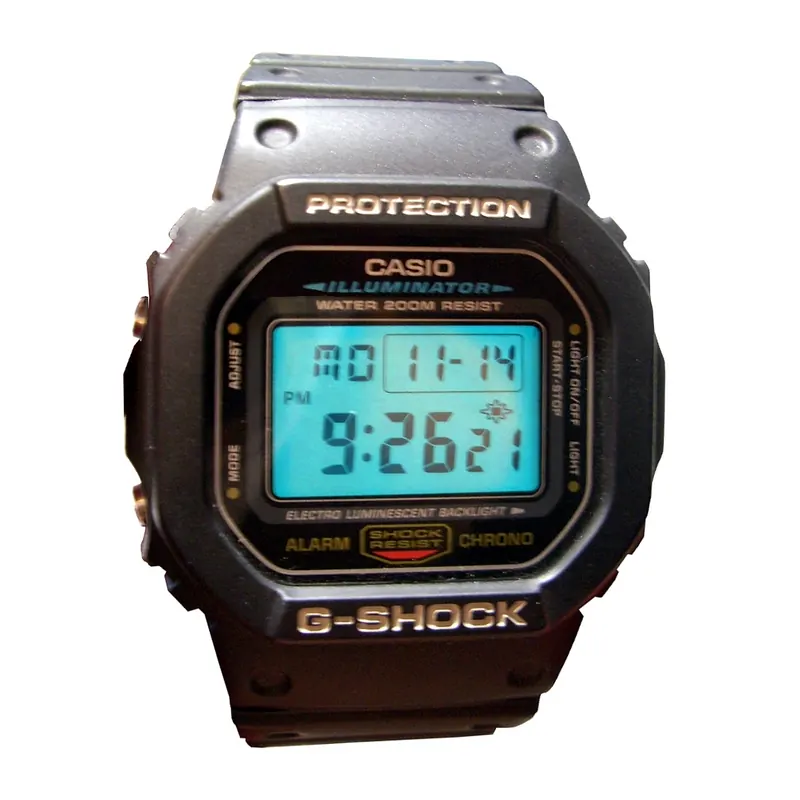
G-Shock DW5600 (5600 Series)
Ref. DW5600E-1VA 200 m rating plus shock-resistant construction makes this the simplest answer for water, sport and travel.
Best for: Swimming, sport and rough use
- MovementDigital quartz
- Case size42.8 mm
- Water resistance200 m (660 ft)
- CrystalMineral glass
Strengths
- 200 m water resistance
- Shock resistant
- Backlight and stopwatch
Limitations
- Casual digital look
Citizen Promaster Diver Eco-Drive — never needs a battery change
Promaster Diver Eco-Drive
Ref. BN0150-28EA light-powered 200 m dive watch with a unidirectional bezel — charge it in daylight and forget about batteries.
Best for: Beach holidays and owners who want zero fuss
- MovementSolar quartz (E168)
- Case size44 mm
- Water resistance200 m (660 ft)
- CrystalAnti-reflective mineral crystal
Strengths
- Eco-Drive solar power
- 200 m water resistance
- Rubber strap suits water
Limitations
- 44 mm case wears large
- Mineral crystal
Orient Kamasu — an automatic diver with sapphire
Kamasu (Mako III) Automatic Diver
Ref. RA-AA0003R19AOne of the few affordable automatic divers with a sapphire crystal and a 200 m rating.
Best for: An automatic you can swim with
- MovementAutomatic (F6922)
- Case size41.8 mm
- Water resistance200 m (660 ft)
- CrystalSapphire
Strengths
- Sapphire crystal
- 200 m water resistance
- Hacking and hand-winding
Limitations
- Bracelet is basic at this price
Seiko Prospex “Turtle” — the heritage choice
Prospex Sea 'Turtle' Diver
Ref. SRPE93A cushion-cased 200 m automatic diver with one of the most recognisable designs in affordable diving watches.
Best for: Larger wrists and serious water use
- MovementAutomatic (4R36)
- Case size45 mm
- Water resistance200 m (660 ft)
- CrystalHardlex
Strengths
- 200 m water resistance
- Screw-down crown
- Long design heritage
Limitations
- 45 mm case is large
- Hardlex crystal, not sapphire
Seiko 5 Sports SRPD — the everyday automatic you can swim in
5 Sports SKX Series
Ref. SRPD55100 m of water resistance in a sporty automatic that works just as well at a desk.
Best for: One watch for work and the weekend
- MovementAutomatic (4R36)
- Case size42.5 mm
- Water resistance100 m (330 ft)
- CrystalHardlex
Strengths
- 100 m water resistance
- In-house 4R36 automatic
- Day-date display
Limitations
- Not a certified diver's watch
Features that keep water out
- Screw-down crown: threads compress a gasket. Always screw it fully home before getting wet.
- Screw-down caseback: generally more secure than a press-fit back.
- The right strap: rubber, silicone, fabric or steel — never leather in water.
- Fresh gaskets: seals age. Have water resistance re-tested periodically if you swim regularly, and after any battery change.
What our old list got wrong
The original version of this page recommended an unbranded “business class” fashion watch and described products as “waterproof”. We’ve replaced it with watches whose ratings are published by established manufacturers, and we no longer use the word waterproof except to explain why it’s misleading.
How water resistance is tested
Understanding how a rating is produced explains why it shouldn’t be read as a depth. Manufacturers test watches in controlled conditions: the watch is placed in a chamber and exposed to air or water pressure equivalent to the rated depth, often alongside other checks for condensation and leakage. ISO 22810 sets out tests for general water-resistant watches, and ISO 6425 sets out a stricter, more extensive regime for divers’ watches, including tests for resistance to thermal shock, magnetic fields and shocks, plus requirements such as a time-preset device (usually a rotating bezel) and legibility in the dark.
Real life is less tidy than a test chamber. When you swim, your arm moves through the water; when you dive into a pool, the impact briefly raises pressure; when you step from a hot beach into cold sea, the case and seals contract. Seals also harden with age and exposure to sun, chlorine and soap. That’s why a 30 m watch isn’t a swimming watch even though you’ll never swim 30 metres down, and why we recommend at least 100 m for regular swimming.
Choosing by activity
Everyday wear, rain and hand-washing
Any watch with a 30 m (3 bar) rating handles splashes and rain. If you’ll never swim with it, you can choose almost any well-made watch — including leather-strapped dress watches.
Swimming and the beach
Look for 100 m and a strap that can get wet. The Seiko 5 Sports SRPD and G-Shock DW5600 are good everyday choices. Rinse the watch in fresh water after the sea or a chlorinated pool, and dry it before storing it.
Snorkelling and water sports
Choose 200 m with a screw-down crown for extra margin against knocks and pressure spikes. The Citizen Promaster Diver, Orient Kamasu and Seiko Turtle are built for this kind of use.
Recreational scuba
Use a watch designed and labelled as a diver’s watch, and treat it as a backup to a dive computer rather than a replacement. A unidirectional bezel lets you time a dive; good lume lets you read it in dark water.
Maintenance that keeps water out
Water resistance is a property you maintain, not a permanent feature:
- Pressure-test periodically. If you swim regularly, have the watch pressure-tested from time to time — many owners do it annually, and certainly after any battery change or caseback opening.
- Replace gaskets during servicing. Seals are inexpensive parts that do a critical job.
- Check the crown every time. An unscrewed crown is the most common cause of water ingress on screw-down watches.
- Avoid heat and chemicals. Hot tubs, saunas, steam rooms, solvents, perfume and harsh soaps all accelerate seal ageing.
- Act fast if it fogs. Condensation under the crystal means moisture got in. Stop wearing it in water and have it checked before corrosion starts.
Straps for wet conditions
Rubber and silicone straps are the natural partners for water. FKM rubber, used on many dive watches, is especially resistant to salt water, sunlight and chlorine. NATO-style fabric straps dry quickly and are cheap to replace. Steel bracelets are ideal too, though salt can build up between links — a quick rinse and a soft toothbrush keep them clean. Leather is the one to avoid: water stains it, weakens the stitching and can leave it smelling. If you love leather, keep a second, water-friendly strap for holidays.
Quartz, solar or automatic for water use?
Movement type doesn’t change water resistance, but it changes ownership. Quartz watches need occasional battery changes, each of which means opening the case — so ask for a seal check each time. Solar watches like Citizen’s Eco-Drive avoid routine battery changes, keeping the case sealed for longer. Automatics need no battery at all but should be serviced every several years; the gaskets are replaced as part of a proper service. If you want the lowest-maintenance swimming watch, a solar diver is hard to beat. Read automatic vs quartz watches for the full comparison.
Sizing a dive-style watch
Many water-ready watches are large. Dive watches in particular often measure 42–45 mm with chunky bezels. Before buying, compare the lug-to-lug length with your wrist using our wrist size calculator, or compare two models side by side in the watch size comparison tool. A watch that sits securely and comfortably is also less likely to take knocks in the water.
Myths about water-resistant watches
“A 50 m watch is fine for diving”
No. A 50 m rating describes a test pressure, not a safe depth. For diving, use a purpose-built diver’s watch alongside a dive computer.
“Once water resistant, always water resistant”
Seals age, harden and can be damaged by heat, chemicals and impacts. Water resistance needs periodic checking, especially after the case has been opened.
“Automatic watches can’t get wet”
Movement type has nothing to do with it. An automatic diver rated to 200 m is perfectly happy in the sea; a quartz dress watch rated to 30 m isn’t.
“The crown doesn’t matter”
The crown is one of the main entry points for water. On screw-down crowns, always screw it fully closed; never pull it out underwater.
“Hot showers are fine with a 100 m watch”
Pressure isn’t the issue; heat and steam are. Rapid temperature changes and soap can degrade seals over time, so many manufacturers advise against it.
Our recommendation in brief
For most men who swim occasionally, a 100 m watch with a rubber, fabric or steel strap is enough. If you’re in the water often, choose 200 m and a screw-down crown. Keep the seals checked, rinse after salt water and chlorine, and your watch will stay dry for years. If you’re unsure which rating fits your plans, our interactive water resistance guide suggests a minimum rating for each activity and lists matching watches from our database.
Frequently asked questions
Is any watch truly waterproof?
No. Standards only allow “water resistant” plus a rating, because seals can always be compromised by age, impacts or heat.
Can I shower with a 100 m watch?
Pressure isn’t the problem; hot water, steam and soap can age seals over time. Many manufacturers advise against it.
What rating do I need for swimming?
We’d look for 100 m or more. Some brands allow light swimming at 50 m, but 100 m gives a sensible margin.
Do I need a diver’s watch for snorkelling?
No — 100 m is generally enough. A 200 m diver adds margin and a bezel for timing.
Why did my watch fog up?
Moisture got inside, often through an ageing gasket or an unscrewed crown. Stop wearing it in water and have it serviced promptly.
Final word
Ignore the word “waterproof” and look for a real rating: 100 m for swimming, 200 m if you’re in the water a lot. The G-Shock DW5600 is the toughest simple choice; the Citizen Promaster Diver is the easiest to live with; and the Orient Kamasu is our pick if you want an automatic with sapphire. For more options, see the best affordable dive watches.
You may also like
Best Watches Under $500
Ten watches from Seiko, Orient, Citizen and Tissot, each chosen for a specific job, from dress and dive to travel and solar no-fuss wear.
Best Automatic Watches for Beginners
Seven automatics and one hand-wound alternative for a first mechanical watch, with hacking, hand-winding, power reserve and accuracy explained.
Best Affordable Dive Watches
Five divers from a budget Casio to a Swiss step-up, plus what ISO 6425, unidirectional bezels, lume and screw-down crowns actually mean.