Best Automatic Watches for Beginners
Seven automatics and one hand-wound alternative for a first mechanical watch, with hacking, hand-winding, power reserve and accuracy explained.
We independently research every product we recommend. If you buy through links on this page, we may earn a commission at no extra cost to you. Learn more
In this article
- Automatic watch basics for beginners
- Hacking
- Hand-winding
- Power reserve
- Accuracy expectations
- Our picks for the best automatic watches for beginners
- Seiko 5 Sports SRPD55
- 5 Sports SKX Series
- Orient Bambino 38mm
- Bambino 38mm (Version 7)
- Orient Kamasu
- Kamasu (Mako III) Automatic Diver
- Citizen Tsuyosa
- Tsuyosa Automatic
- Seiko Presage Cocktail Time SRPB43
- Presage Cocktail Time
- Hamilton Khaki Field Auto 38mm
- Khaki Field Auto 38mm
- Tissot PRX Powermatic 80
- PRX Powermatic 80 40mm
- Hand-wound alternative: Hamilton Khaki Field Mechanical 38mm
- Khaki Field Mechanical 38mm
- Caring for your first automatic
- How we chose
- Frequently asked questions
- The bottom line
An automatic watch runs on springs, gears and a swinging rotor rather than a battery. Every movement of your wrist winds it a little, and a balance wheel ticking back and forth several times a second keeps time. For many people that small machine is the whole point, and the first automatic is often where an interest in watches really starts.
It’s also where newcomers run into unfamiliar terms: hacking, hand-winding, power reserve, seconds per day. This guide explains each one, then recommends seven automatics (and one hand-wound alternative) that make sensible first purchases, from affordable Japanese models to Swiss pieces with 80-hour reserves.
| Watch | Movement | Case size | Water resistance | Crystal | Best for | Link |
|---|---|---|---|---|---|---|
| Seiko 5 Sports SKX SeriesSRPD55 | Automatic (4R36) | 42.5 mm | 100 m (330 ft) | Hardlex | A first automatic for everyday wear | Check Price |
| Orient Bambino 38mm (Version 7)RA-AC0M01S | Automatic (F6724) | 38.4 mm | 30 m (100 ft) | Domed mineral glass | Office and formal wear | Check Price |
| Orient Kamasu (Mako III) Automatic DiverRA-AA0003R19A | Automatic (F6922) | 41.8 mm | 200 m (660 ft) | Sapphire | An automatic diver | Check Price |
| Citizen Tsuyosa AutomaticNJ0150-56L | Automatic (8210) | 40 mm | 50 m (160 ft) | Sapphire | A colorful bracelet watch | Check Price |
| Seiko Presage Cocktail TimeSRPB43 | Automatic (4R35) | 40.5 mm | 50 m (160 ft) | Box-shaped Hardlex | Evenings and smart occasions | Check Price |
| Hamilton Khaki Field Auto 38mmH70455133 | Automatic (H-10) | 38 mm | 100 m (330 ft) | Sapphire | A do-it-all Swiss automatic | Check Price |
| Tissot PRX Powermatic 80 40mmT137.407.11.041.00 | Automatic (Powermatic 80) | 40 mm | 100 m (330 ft) | Sapphire, anti-reflective coating on underside | One watch for office and weekend | Check Price |
“Check Price” links go to Amazon (affiliate links). We don’t list prices because they change frequently.
Automatic watch basics for beginners
Hacking
A movement that “hacks” stops the seconds hand when you pull the crown out to set the time. That lets you sync the watch to the exact second against your phone. Without it, you can only set the time to within a few seconds. It’s a small convenience, but a welcome one.
Hand-winding
Some automatics can also be wound by turning the crown. That matters when you pick up a stopped watch: a few turns get it running and give the mainspring a head start, rather than relying on wrist motion alone. Movements without hand-winding have to be shaken or worn to get going.
Power reserve
Power reserve is how long a fully wound watch runs once you take it off. Around 40 hours is typical of affordable movements, which means a watch left on the nightstand on Friday evening may have stopped by Sunday. Modern Swiss movements with 80-hour reserves will run through a weekend. If you rotate between several watches, a longer reserve makes a real difference. Our article on whether you need a watch winder covers the alternatives.
Accuracy expectations
Set your expectations before you buy. Quartz watches typically drift by seconds per month; mechanical watches drift by seconds per day. Affordable automatics can gain or lose a handful of seconds to tens of seconds a day depending on position, temperature and how fully wound they are. For reference, COSC chronometer certification requires a tested movement to stay within -4 to +6 seconds per day. Resetting an automatic every week or so is normal and not a sign of a fault. If that sounds like a nuisance, read our automatic vs quartz comparison or try the interactive automatic vs quartz tool before choosing.
Our picks for the best automatic watches for beginners
Seiko 5 Sports SRPD55
5 Sports SKX Series
Ref. SRPD55The 4R36 hacks, hand-winds and runs approx. 41 hours, in a 100 m steel case with a see-through back.
Best for: A first automatic for everyday wear
- MovementAutomatic (4R36)
- Case size42.5 mm
- Water resistance100 m (330 ft)
- CrystalHardlex
Strengths
- Hacking and hand-winding
- 100 m water resistance
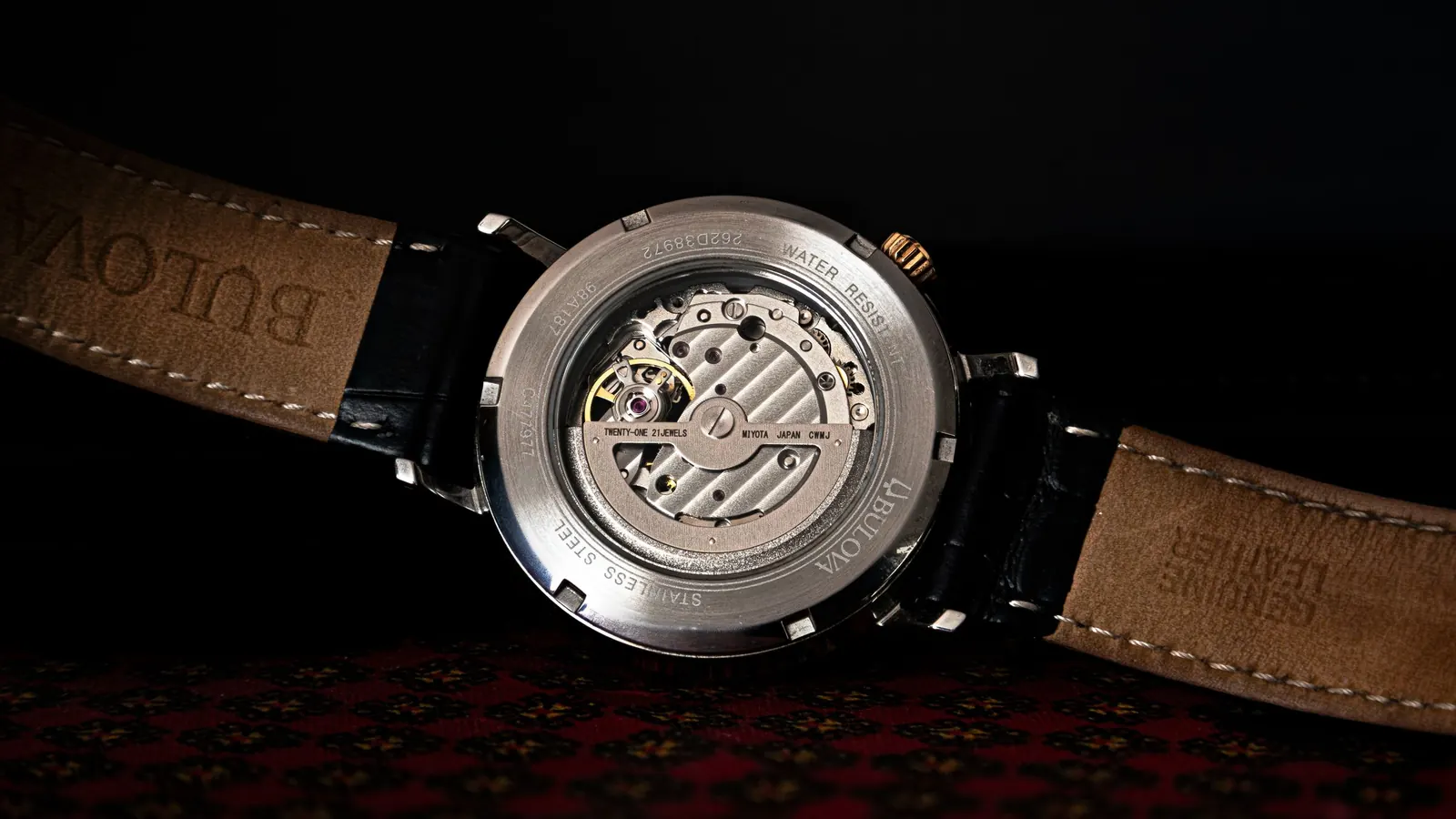
- See-through case back to watch the movement
Limitations
- Hardlex crystal
- 13.4 mm thick
This is the default recommendation for a reason. Seiko’s 4R36 movement has every beginner-friendly feature: hacking, hand-winding and a day/date. It sits in a 42.5 mm stainless steel case with a unidirectional bezel, LumiBrite lume, a see-through screw case back and 100 m of water resistance, which is enough that you won’t need to take it off for a swim.
It’s a good watch to learn on. If it runs a little fast or slow, you’ll learn the habit of resetting it, and the display back lets you see the rotor that winds it. Read our Seiko 5 Sports review for a closer look.
Orient Bambino 38mm
Bambino 38mm (Version 7)
Ref. RA-AC0M01SOrient's in-house F6724 with hacking, hand-winding and 40 hours of reserve under a domed crystal.
Best for: Office wear and formal occasions
- MovementAutomatic (F6724)
- Case size38.4 mm
- Water resistance30 m (100 ft)
- CrystalDomed mineral glass
Strengths
- Hacking and hand-winding
- Domed crystal, exhibition caseback
- 38.4 mm suits most wrists
Limitations
- 30 m water resistance
- Leather strap needs care around water
If your first automatic is meant for work rather than weekends, the Bambino makes a lot of sense. Orient makes the F6724 movement itself and gives it hacking and hand-winding, along with a 40-hour power reserve. The 38.4 mm case and domed crystal give it a classic look, and the exhibition caseback shows the movement working.
The 30 m rating means no swimming. Treat it as a desk-and-dinner watch.
Orient Kamasu
Kamasu (Mako III) Automatic Diver
Ref. RA-AA0003R19ASapphire crystal, 200 m water resistance and an in-house automatic with hacking and hand-winding.
Best for: An automatic dive watch on a modest budget
- MovementAutomatic (F6922)
- Case size41.8 mm
- Water resistance200 m (660 ft)
- CrystalSapphire
Strengths
- Sapphire crystal
- 200 m water resistance
- Hacking, hand-winding and day/date
Limitations
- 13 mm thick
- 40-hour reserve
For a beginner who wants a tougher, sportier automatic, the Kamasu adds two things the Seiko 5 lacks: a sapphire crystal and a 200 m rating. The F6922 movement hacks and hand-winds, and the 41.8 mm case comes on a steel bracelet with a push-button deployant clasp.
It’s one of the few watches at its price that combines an automatic movement with sapphire and a 200 m rating, which makes it good value on paper.
Citizen Tsuyosa
Tsuyosa Automatic
Ref. NJ0150-56LA sapphire-crystal integrated-bracelet automatic with a 42-hour reserve and bright dial options.
Best for: A colorful everyday automatic on a bracelet
- MovementAutomatic (8210)
- Case size40 mm
- Water resistance50 m (160 ft)
- CrystalSapphire
Strengths
- Sapphire crystal
- 42-hour power reserve with hacking
- Integrated steel bracelet
Limitations
- 50 m water resistance
- Integrated design limits strap swaps
Integrated-bracelet watches are popular, and the Tsuyosa offers the look with an automatic movement at a lower price band than Swiss alternatives. Citizen’s 8210 calibre hacks and has a 42-hour reserve; the 40 mm case is 12.1 mm thick with a sapphire crystal and magnified date.
It’s a cheerful, colorful choice, and a sensible stepping stone toward a pricier integrated-bracelet watch later.
Seiko Presage Cocktail Time SRPB43
Presage Cocktail Time
Ref. SRPB43A textured dial under a box-shaped Hardlex crystal, with the 4R35 automatic inside.
Best for: Evenings and smart occasions
- MovementAutomatic (4R35)
- Case size40.5 mm
- Water resistance50 m (160 ft)
- CrystalBox-shaped Hardlex
Strengths
- Distinctive textured dial
- Hacking and hand-winding
- See-through case back
Limitations
- Hardlex crystal
- Leather strap
Some first automatics are bought simply because they look good, and the Cocktail Time is one of them. Its textured dial is the attraction. Inside is Seiko’s 4R35, which hacks, hand-winds and has approximately 41 hours of reserve, in a 40.5 mm case 11.8 mm thick.
With 50 m of water resistance it’s a little more robust than the Bambino, but it’s still a dress watch first.
Hamilton Khaki Field Auto 38mm
Khaki Field Auto 38mm
Ref. H70455133An 80-hour Swiss automatic with sapphire crystal and 100 m water resistance on a steel bracelet.
Best for: A do-it-all Swiss automatic
- MovementAutomatic (H-10)
- Case size38 mm
- Water resistance100 m (330 ft)
- CrystalSapphire
Strengths
- 80-hour power reserve
- Sapphire crystal and 100 m rating
- Nivachron balance spring
Limitations
- Sits in the $500–$1,000 band
- Field styling is casual rather than formal
If you can stretch your budget, the Khaki Field Auto fixes most of the weaknesses of cheaper automatics. Hamilton’s H-10 movement has an 80-hour power reserve, so it survives a weekend off the wrist, and a Nivachron balance spring designed to resist magnetism. You also get a sapphire crystal, 100 m of water resistance and Super-LumiNova.
The 38 mm case is 11 mm thick with a 47 mm lug-to-lug, a versatile size. It is typically sold in the $500–$1,000 range.
Tissot PRX Powermatic 80
PRX Powermatic 80 40mm
Ref. T137.407.11.041.00A slim Swiss integrated-bracelet automatic with an 80-hour reserve and sapphire crystal.
Best for: One watch for office and weekend
- MovementAutomatic (Powermatic 80)
- Case size40 mm
- Water resistance100 m (330 ft)
- CrystalSapphire, anti-reflective coating on underside
Strengths
- 80-hour power reserve
- 10.93 mm thick with sapphire crystal
- 100 m water resistance and quick-release bracelet
Limitations
- Sits in the $500–$1,000 band
- Integrated design limits strap choice
The PRX Powermatic 80 does many of the same jobs as the Tsuyosa at a higher level. Tissot quotes an 80-hour reserve, a Nivachron balance spring, a sapphire crystal with anti-reflective coating on the underside, and 100 m water resistance, all in a 40 mm case just 10.93 mm thick.
The slim 10.93 mm case and quick-release bracelet make it versatile. See our PRX Powermatic 80 review for more.
Hand-wound alternative: Hamilton Khaki Field Mechanical 38mm
Khaki Field Mechanical 38mm
Ref. H69439931A slim 9.5 mm hand-wound field watch with an 80-hour reserve and sapphire crystal.
Best for: Smaller wrists and lovers of mechanical simplicity
- MovementHand-wound (H-50)
- Case size38 mm
- Water resistance50 m (160 ft)
- CrystalSapphire
Strengths
- 80-hour power reserve
- Slim 9.5 mm case
- Sapphire crystal
Limitations
- Must be wound by hand
- 50 m water resistance
This isn’t an automatic; it has no rotor, so you wind it by turning the crown. Some people find that daily ritual is the most enjoyable part of owning a mechanical watch. The lack of a rotor also keeps the case to 9.5 mm thick. Hamilton’s H-50 calibre runs for 80 hours, so missing a day of winding isn’t a problem.
It’s typically sold in the $500–$1,000 range, with sapphire and 50 m water resistance.
Caring for your first automatic
- Wind it if it stops. If your watch hand-winds, 20–30 turns of the crown is a common rule of thumb to get it going. Otherwise, wear it or gently swing it.
- Avoid magnets. Speakers, laptop lids and bag clasps can magnetize a balance spring and make it run fast. Nivachron springs help resist this.
- Don’t set the date late at night. On many automatics, changing the date while the date mechanism is engaged (roughly 9 pm to 3 am) can damage it. Check your manual.
- Service occasionally. Mechanical movements need cleaning and oiling every several years. Inexpensive movements are often cheaper to replace than to service.
- Respect water ratings. Our water resistance guide explains what each figure means.
Ready for something cheaper?
If an automatic isn’t essential, our watches under $100 guide covers durable quartz options.
How we chose
We haven’t hands-on tested these watches. This guide is built on research: we compared manufacturer specifications from Seiko, Orient, Citizen, Hamilton and Tissot, weighed each movement’s features and track record, and considered value within each watch’s price band. Every figure here comes from published specifications. Our methodology page has the details.
Frequently asked questions
What’s the difference between automatic and mechanical?
All automatics are mechanical, but not all mechanical watches are automatic. An automatic has a rotor that winds it as you move; a hand-wound mechanical watch, like the Hamilton Khaki Field Mechanical, has to be wound by the crown.
Do automatic watches need a battery?
No. They are powered by a mainspring wound by your wrist movement, or by the crown on models that hand-wind.
How long will an automatic run off the wrist?
That’s the power reserve. The Seiko, Orient and Citizen picks here run around 40–42 hours; the Hamilton and Tissot picks run up to 80 hours.
Why does my automatic gain or lose time?
Mechanical movements are affected by position, temperature and wind state. Drift of several seconds a day is normal for affordable automatics.
Do I need a watch winder?
Usually not. If your watch hand-winds or has a long power reserve, simply resetting it is easy. Winders are mainly a convenience for people who rotate several automatics.
The bottom line
For most beginners the Seiko 5 Sports SRPD55 is the natural first automatic, offering every useful feature at an accessible price. The Orient Bambino suits a dressier wardrobe, and the Kamasu gets you sapphire and 200 m. If you can stretch, the Hamilton Khaki Field Auto and Tissot PRX Powermatic 80 bring 80-hour reserves that make automatic ownership noticeably easier.
You may also like
Best Watches Under $500
Ten watches from Seiko, Orient, Citizen and Tissot, each chosen for a specific job, from dress and dive to travel and solar no-fuss wear.
Best Affordable Dive Watches
Five divers from a budget Casio to a Swiss step-up, plus what ISO 6425, unidirectional bezels, lume and screw-down crowns actually mean.
Tissot PRX Powermatic 80 Review: Is the 80-Hour Swiss Automatic Worth It?
A slim, integrated-bracelet Swiss automatic with an 80-hour reserve. We look at what the specs promise, where it falls short and who should buy it.