Choosing a Nurse Watch: What You Need to Know
Fob or wrist, bare-below-the-elbows rules, and the features that matter on a busy shift.
We independently research every product we recommend. If you buy through links on this page, we may earn a commission at no extra cost to you. Learn more
In this article
- Why nurses wear fob watches
- Bare below the elbows: what the rules say
- What to look for in a nurse watch
- A clear, sweeping seconds hand (or a seconds display)
- Legibility
- Night visibility
- Cleanability
- Quartz, not mechanical
- Attachment
- Water resistance
- Types of nurse watch
- Silicone fob watches
- Stainless steel fob watches
- Clip and carabiner watches
- When a wristwatch still makes sense
- Casio F-91W
- F-91W Classic Digital
- Casio G-Shock DW5600
- G-Shock DW5600 (5600 Series)
- Caring for a nurse watch
- Frequently asked questions
- The bottom line
Nurses check the time constantly: for medication rounds, for charting, and above all for counting a pulse or a breathing rate against a moving seconds hand. Yet many nurses can’t simply wear an ordinary wristwatch on shift. Infection-control dress codes in a lot of hospitals ask clinical staff to keep their forearms bare, and that rules out the most obvious option.
This guide explains why the nurse’s fob watch exists, what the “bare below the elbows” rules actually say, and which features matter when you choose a watch for clinical work. It also covers the situations where a tough, washable wristwatch is still a sensible choice.
Why nurses wear fob watches
The traditional nurse’s watch is a small pocket watch with a pin or clip, worn on the chest or pinned to a tunic. What makes it a nurse’s watch rather than a plain pocket watch is the dial: it is printed upside down. When the watch hangs from your uniform and you tip it up with one hand, or simply glance down at it, the numerals read the right way round. You never have to unpin it or turn it over.
That design solves two problems at once. Your hands stay free for patient care, and the watch never touches the patient, the bed rails or the gloves you are wearing. It also keeps the watch away from the area you scrub during hand hygiene, which is the point of most modern dress codes.
Bare below the elbows: what the rules say
In the UK, many NHS trusts follow a “bare below the elbows” (BBE) policy in clinical areas. Staff wear short sleeves or roll them up, and remove wristwatches, bracelets, fitness trackers and rings with stones, so that hands and wrists can be washed or sanitized properly. National ambulance infection-control guidance goes as far as stating that BBE includes removing wristwatches even those with washable straps. Several trust policies then name the fob watch as the accepted alternative.
In the US, the picture is less uniform. In 2014 the Society for Healthcare Epidemiology of America (SHEA) published expert guidance on healthcare attire that suggested hospitals consider a bare-below-the-elbows approach for inpatient care, including no wristwatches during clinical practice. It was framed as an option for facilities to adopt, not a national rule, and the authors were open that the evidence linking clothing and accessories to infection is limited. Later reviews have reached similar conclusions: the evidence specifically on wristwatches is thin and mixed.
The practical takeaway is simple. Your employer’s uniform policy is what counts, and it can differ between hospitals, departments and even wards. Check it before you buy anything. If your workplace follows BBE, a fob watch or clip watch is the answer. If it doesn’t, you have more freedom, and a washable wristwatch may suit you better.
Before you buy
Read your hospital’s or agency’s uniform and dress code policy, or ask your ward manager or infection prevention team. Policies vary by country, by employer and sometimes by department, and they change over time.
What to look for in a nurse watch
A clear, sweeping seconds hand (or a seconds display)
This is the single most important feature. Pulse and respiration counts depend on watching seconds pass. A common bedside approach is to count beats for 30 seconds and double it, though many clinical guides recommend counting for a full 60 seconds when the rhythm is irregular, and respiration is often counted for longer as well. Whatever method you use, you need a seconds hand that is easy to follow at a glance, with clearly marked minute track divisions. A digital watch with a seconds readout or stopwatch works too.
Legibility
Look for a high-contrast dial, bold numerals and hands that stand out from the background. Very small or decorative dials might look elegant on a lapel, but they are harder to read when you are tired, in dim light on a night shift, or reading upside down at chest level. Some nurses prefer a 24-hour dial, which matches clinical charting in many hospitals.
Night visibility
Night shifts mean dim wards. A luminous dial or a backlight lets you read the time without switching on a light near a sleeping patient. Lume needs charging from light and fades over the night; a battery backlight gives a consistent glow at the press of a button.
Cleanability
Whatever you wear will be handled with gloved or freshly sanitized hands many times a shift. A smooth, sealed silicone cover or a simple stainless steel case is much easier to wipe down than a textured case, a fabric strap or anything set with crystals. Avoid crevices where dirt can collect. If you buy a silicone fob watch, check whether the watch head can be removed so the cover can be cleaned separately.
Quartz, not mechanical
Almost all nurse watches use battery-powered quartz movements, and for good reason. They are accurate, inexpensive, and don’t need winding or regular wear to keep running. A mechanical watch pinned to a tunic gets no help from wrist motion, so an automatic would soon stop. (For background, see our guide to automatic vs quartz watches.)
Attachment
Pins are traditional but can wear holes in thin tunics over time. Clips and carabiner-style fob watches attach to a pocket, belt loop or lanyard instead. Whatever style you choose, make sure the attachment is secure, because a watch that falls into a sink or onto a floor is a hassle you don’t need.
Water resistance
A nurse watch will be splashed and wiped, not submerged. Basic splash resistance is enough for most people, but a higher rating gives peace of mind if you clean it often. Our water resistance explainer covers what the ratings really mean.
Types of nurse watch
Silicone fob watches
The most common option today is a small quartz watch inside a soft silicone cover, with a pin on the back. They come in many colors, which some nurses use to tell their watch apart from colleagues’. They are lightweight, inexpensive and easy to wipe clean. Retailers commonly sell them with large, simple dials; some have a 24-hour track. Build quality and accuracy vary from seller to seller, so buy from a supplier that names the movement and offers a warranty.
Browse silicone nurse fob watches on AmazonStainless steel fob watches
A steel fob watch is more durable and looks smarter on a uniform. A good example is the Lorus RG253CX9, a nurse’s fob watch from Seiko’s value brand. By the retailers’ listings, it has a quartz movement, a 30mm stainless steel case, a Hardlex crystal, 30m water resistance and a dial coated in Lumibrite luminous paint, so the whole face glows in the dark. Its sibling, the RG251CX9, has a conventional white dial. One UK retailer lists the RG253CX9 as no longer available while others still stock it, so it may be getting harder to find.
Check Price on AmazonClip and carabiner watches
Carabiner watches clip to a belt loop, bag or lanyard. They tend to be chunkier and more rugged than lapel watches, and many have large luminous dials. Some digital versions add a stopwatch or countdown timer, which can be useful for timing. They usually don’t have a pin, so they suit people who prefer to keep the watch on a belt or lanyard. As with silicone fob watches, quality varies widely, so check the seller’s specifications carefully.
Browse clip and carabiner watches on AmazonWhen a wristwatch still makes sense
Not every healthcare worker is covered by bare-below-the-elbows rules. Some hospitals don’t apply them, and many roles in community care, clinics, education or management sit outside clinical areas. For those settings, or for the commute and break room, a light, washable digital watch is hard to beat. Both of the following have resin cases and straps that can be wiped down, and their digital displays show seconds clearly.
Casio F-91W
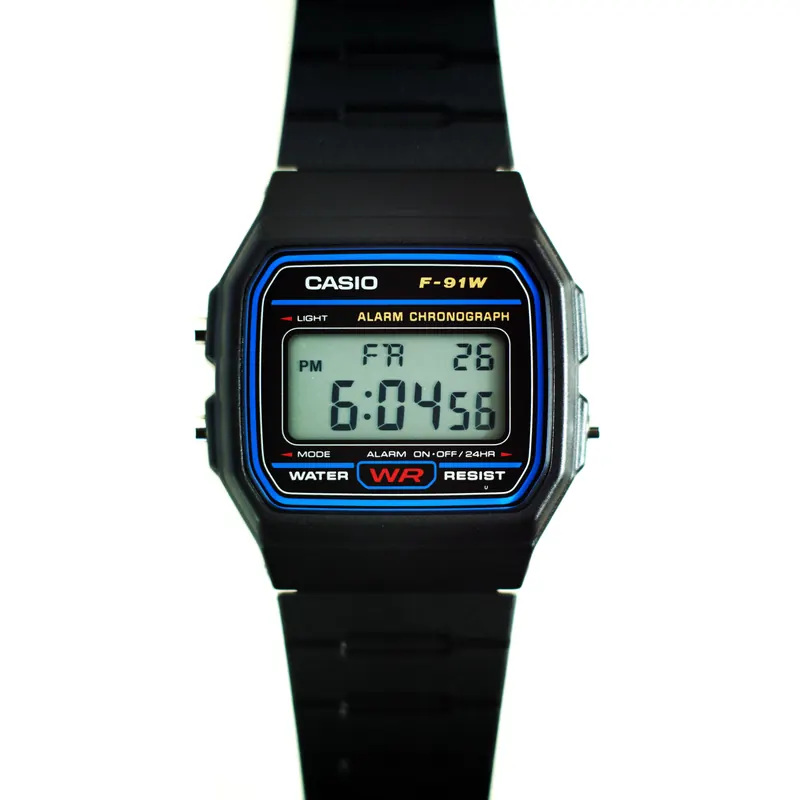
Photo: Ashley Pomeroy (CC BY-SA 3.0)
F-91W Classic Digital
Ref. F91W-1A featherweight resin digital with a seconds readout, LED light and 1/100-second stopwatch, cheap enough that a lost or damaged one isn't a disaster.
Best for: Roles where wristwatches are allowed, or as a backup watch in a bag
- MovementDigital quartz
- Case size35.2 mm
- Water resistanceWater resistant (splash only)
- CrystalResin glass
Strengths
- Very light and inexpensive
- Seconds always visible on the display
- Stopwatch for timing
Limitations
- Only splash resistant
- Small display and modest backlight
Casio G-Shock DW5600
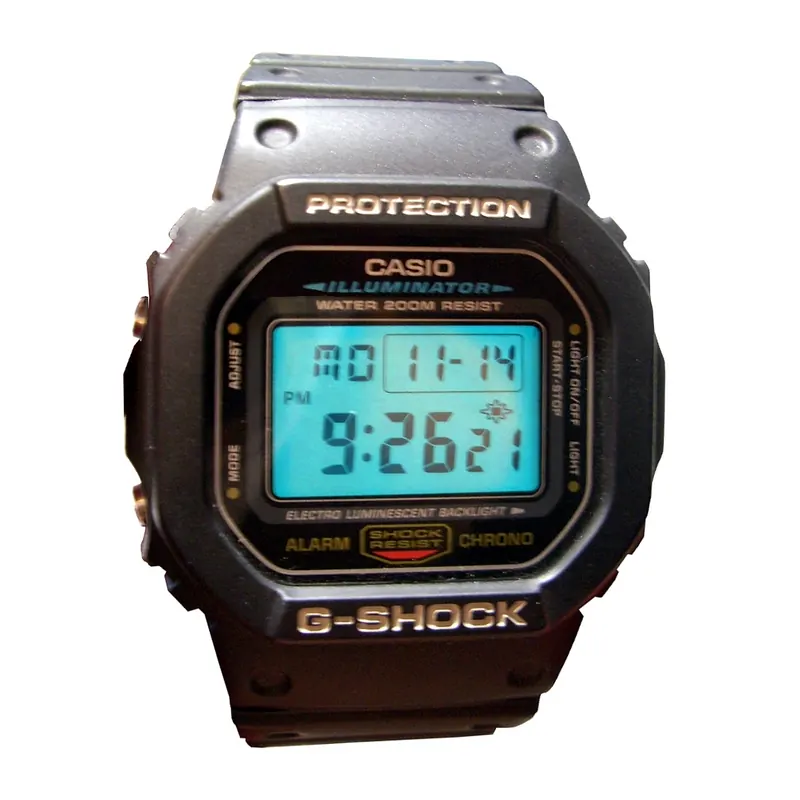
G-Shock DW5600 (5600 Series)
Ref. DW5600E-1VShock resistant and rated to 200m, with a resin case and band that shrug off frequent cleaning and knocks.
Best for: Paramedics off-duty, community and field roles where wristwatches are permitted
- MovementDigital quartz
- Case size42.8 mm
- Water resistance200 m (660 ft)
- CrystalMineral glass
Strengths
- Shock resistant
- 200m water resistance
- Backlight with afterglow and a 1/100-second stopwatch
Limitations
- Bulkier than a fob watch
- Still not acceptable under bare-below-the-elbows rules
If you’re not sure what size suits you, our guide to measuring your wrist helps, and the best watches under $100 round-up has more inexpensive options.
Caring for a nurse watch
- Clean it as often as your hands. Wipe it with the disinfectant wipes approved by your workplace, especially after any contact with body fluids. Avoid soaking it unless the maker says you can.
- Replace the battery promptly. A quartz watch that starts running slow or whose seconds hand jumps in multi-second steps often has a low battery.
- Check the pin or clip. Bent pins and loose clips are the usual way fob watches get lost.
- Keep a spare. Fob watches are inexpensive, so many nurses keep a second one in their locker or bag.
Frequently asked questions
Why is the dial on a nurse’s watch upside down?
So it reads the right way up when it hangs from your uniform and you tilt it toward you or glance down at it. You never have to unpin it or turn it over.
Can nurses wear wristwatches?
It depends on the employer. Many hospitals, particularly NHS trusts in the UK, apply a bare-below-the-elbows policy that rules out wristwatches in clinical areas. Others don’t. Always check your own uniform policy.
Is a digital or analog nurse watch better?
Either works if you can read seconds easily. Many nurses find a sweeping seconds hand intuitive for counting a pulse; others prefer a digital seconds readout or stopwatch.
Are silicone fob watches better for infection control?
They are easy to wipe clean and have few crevices, which is why they are popular. No watch replaces proper hand hygiene, and your employer’s policy decides what is acceptable.
Do I need a luminous dial?
It helps a lot on night shifts. A fully luminous dial or backlight lets you check the time on a dark ward without turning on a light.
Should a nurse watch be automatic?
No. A fob watch gets no wrist movement to wind an automatic movement, so it would stop. A quartz watch is more practical and accurate.
The bottom line
Check your uniform policy first. If you work under bare-below-the-elbows rules, choose a legible quartz fob watch with a clear seconds hand, a luminous dial for nights and a secure pin or clip — silicone for easy cleaning, steel for durability. Where wristwatches are allowed, a light, washable digital such as a Casio is a practical choice. For more affordable options, see our best watches under $100.
You may also like
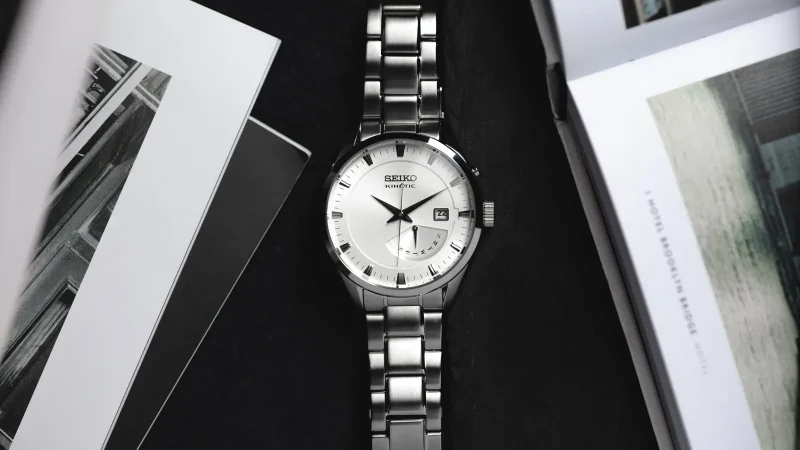
Best Watches Under $500
Ten watches from Seiko, Orient, Citizen and Tissot, each chosen for a specific job, from dress and dive to travel and solar no-fuss wear.
Best Watches Under $100
Five Casio and Timex watches that do the job for very little money, plus what to expect from crystals, water resistance and quartz at this budget.
Automatic vs Quartz Watches: Which Movement Is Right for You?
Spring and balance wheel or crystal and battery? How each movement works, how accurate they really are, and which suits the way you wear a watch.